
The angels of
science are well aware that truth’s many layers must be peeled back gradually,
as the human consciousness gains in its capacity for knowledge. After Newton’s discovery of white light’s true
nature, the angels allowed time for this knowledge to take root in the human
consciousness before guiding other pioneering scientists to learn more about
the nature of light. In 1800, the German musician and astronomer, Sir
Frederick William Herschel, paid heed to the
angelic instructions that drifted into his mind on the strains of his music and
the light beams of the stars, as he was experimenting with prisms and
thermometers. If it had not been for the
angels’ prodding, he never would have thought to place a thermometer just
outside the visible spectrum of sunlight. His rational mind chastised him:
“What a ridiculous idea, Frederick!” But his curiosity said, “Why not?” Laughing at himself, he placed the thermometer
just beyond the red light, and lo and behold, the temperature increased! So
Frederick discovered infrared radiation: Light that cannot be seen with the
human eye, and yet can be proved to exist.
 |
| Sir Frederick William Herschel |
Once
some of the mysteries of light had been unveiled, it was an easy matter for the
angels to guide scientists to make further discoveries. In 1801, Johann Wilhelm Ritter,
a Polish scientist who had heard about
Herschel’s discovery of infrared light, wondered if invisible light might exist
beyond the violet end of the spectrum as well. The angels nudged him to
consider experimenting with silver
chloride, a chemical which turns black when exposed to sunlight. Johann
directed sunlight through a glass prism to create a spectrum and placed silver
chloride in each color. When he placed it in the area just beyond the violet end
of the spectrum, where no visible light could be seen, the silver chloride deepened into the darkest black, proving that light
existed beyond the scope of human vision on the upper end of the spectrum as
well as the lower end. Johann’s eyes brimmed over with tears. The angels smiled
at each other. Humanity was another step closer to learning the truth about
light; that light pervades all of the universe, seen and unseen, because
EVERYTHING is made of light!
The angels of
science were very busy during the nineteenth century as scientists were eager
to learn everything they could about the properties of light. With some help
from his angelic friends, the British physicist, James Clerk Maxwell, was able
to demonstrate that visible light makes up a minute fraction of the whole
electromagnetic spectrum. Another scientist who contributed to our
growing knowledge of light was Leon
Foucault, a Frenchman who, in 1862, measured the speed of light to be 299,792.458
kilometers per second in a vacuum.
“And now the
skeptics will know that we really do exist!” the angels rejoiced.
Twelve-hundred years earlier the Angel Gabriel had told Mohammed to write in
the Koran that angels travel in one day the same distance that the moon travels
in a thousand lunar years. A thousand lunar years equal twelve-thousand lunar
orbits or earth days . . . which turn out to be the same as the speed of light. “One day people will realize that they are made of light, just as Jesus
told them they are. Then they will travel at the speed of light, too!”
 |
| The Human Light Body |
Throughout
history, scientists have asked the same questions that truth seekers have asked
since the beginning of time: “Where did we come from? Why are we here? How did
the universe begin, and how will it end?” The spiritual seeker looks for
answers by reading scripture, meditating, and praying. The scientist seeks
answers in the laboratory, using telescopes, microscopes, and chemical
formulas. Scientists require physical proof before they will accept the
validity of a spiritual truth. Spiritual truths are explored and expressed in
music, art, and allegory. They cannot always be defined in words or
demonstrated in concrete ways. However, as humanity has matured and learned to
grasp more abstract concepts, the angels of science have been able to convey
deeper truths by steering scientific explorations in the right direction. And
sometimes, a great man, such as Albert Einstein, has the ability to travel both
paths, seeing the light through the lenses of science and of spirit. Albert
wrote in The Merging of Spirit and
Science:
“The
most beautiful and most profound experience is the sensation of the mystical.
It is the sower of all true science. He to whom this emotion is a stranger, who
can no longer wonder and stand rapt in awe, is as good as dead. To know that
what is impenetrable to us really exists, manifesting itself as the highest
wisdom and the most radiant beauty which our dull faculties can comprehend only
in their primitive forms - this knowledge, this feeling is at the center of
true religiousness.”
During the twentieth
century, the science muses worked with Einstein, as well as Monsignor Georges Lemaître, and Edwin Hubble,
to introduce what has become known as the Big Bang Theory, providing a
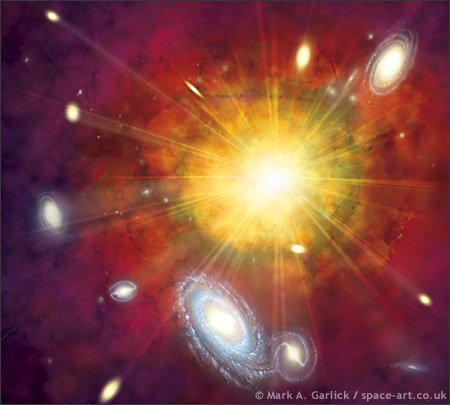
scientific explanation for the origin of the universe. According to the Big Bang model, the
universe started out as an extraordinarily hot, high energy
density that exploded and expanded like fireworks. And what was this
fiery ball of energy, but Love, in its most intense and concentrated form! It was pure Love growing denser and hotter and more jubilant until it
just had to burst forth in a great cosmic orgasm that sent the stars dancing
and spinning out into space. All this Love and Light has been expanding out
into infinity ever since, and everything it has created is still made of the
same Love and Light from which it all began.
The
writer of Genesis says that light was God’s first creation. In Greek mythology,
Eros, the god of love, was the first divine being from which the rest of
creation was brought forth. The
Australian Aborigines believed that the great Father of All Spirits was the
only conscious being before the beginning of time, and the first being he awoke
was the Sun Mother. It was then her job to awaken every living thing in the
world. The angels gave these stories to
the people of ancient times to help them understand that the world was born of
Love and Light. When humanity became more sophisticated, the angels decided we
were ready for the Big Bang Theory. “The best part about this theory,” one
angel said to another, “is that it demonstrates the oneness of creation, with
everything originating from the same cause.”
Albert
Einstein, who was the most highly revered scientist of the twentieth century,
catapulted humanity’s ideas about space and time into a vast new realm of
comprehension, largely because he was attuned to what he referred to as “the
music of the spheres.” His intimate relationship with the muses of science
opened his mind to the importance of understanding our oneness with the cosmos,
as he expressed in these words:
“A
human being is part of the whole called by us universe, a part limited in time
and space. We experience ourselves, our thoughts and feelings as something
separate from the rest. A kind of optical delusion of consciousness. This delusion
is a kind of prison for us, restricting us to our personal desires and to
affection for a few persons nearest to us. Our task must be to free ourselves
from the prison by widening our circle of compassion to embrace all living
creatures and the whole of nature in its beauty. The true value of a human
being is determined by the measure and the sense in which they have obtained
liberation from the self. We shall require a substantially new manner of
thinking if humanity is to survive.”
How wonderful! The
hosts of heaven sang the praises of Albert Einstein, for his work and his words
opened doors and windows for many followers to pass through. The angels have shown others that the
liberation from self this scientist spoke of was the very same liberation Jesus
spoke of when he said: “The truth shall set you free;“ and the same liberation
from materialism that Buddhism teaches. The scientific truths set forth by
Einstein and many more scientists following him serve as links of love in the
expanding bridge between science and spiritual understanding, and Divine Love
is well pleased.
http://www.speed-light.info/measure/fizeau.htm#1849%20Hippolyte%20Louis%20Fizeau_history_speed_light

