Saturday, February 9, 2013

Chapter 19: The Science of Love

Copernicus


As human beings separated themselves from one another and creation, their bodies grew denser and they lost their ability to see what was happening on other planes of reality. When they lost their citizenship in Paradise it was like walking out of the sunlight into a thick fog that obscures everything from sight. The difference is that the “fog” is the material world, which looks solid and well-defined. But there are so many dimensions of life besides the one that remains visible to the human eye. Mystics, scientists, and storytellers are among those who have been intrigued by these invisible realms, but scientists tend to promote the notion that anything that can’t be observed to be real, does not exist.
The world’s mystics, such as the Sufis, have felt that science is to blame for humanity’s ignorance of reality’s multiple layers: Thus the Sufi’s metaphorical and poetic references to sleeping scientists. In sleep, the dreamer is aware only of the subconscious realm as he travels through it, remembering his waking life solely upon leaving the dream. In waking life, most people are aware only of the world they can see, touch, hear, and taste. It’s an ongoing challenge for Love’s emissaries to find ways to awaken them. While many people respond more readily to music, art, and literary symbolism, there are others who can be reached via scientific discovery.  The gentle nudges of angels have led scientists to conceive of the earth’s spherical shape, the rotation of the earth around the sun, and the existence of microscopic life. 
The earliest earth dwellers knew only what they observed about the world around them. They believed that the earth was flat or dome shaped because that’s how it appeared to them. They observed the sun traveling over the domed sky from morning until night, and then the moon and the stars made their way across the heavens, proving to their satisfaction that the earth was the center of the universe. The author of the Book of Joshua wrote that the sun stood still in the heavens while the Israelites conquered their enemy, the Amorites.  The sun had appeared to stand still, and so it was described that way. Three thousand years later, in the early 1500’s, the astronomer, Nicolaus Copernicus, formulated the first heliocentric cosmology much to the dismay of the church fathers, who based their understanding of the universe on that one Bible passage.

Heliocentric Universe


A century later, the Italian astronomer, Galileo Galilei, was sentenced to spend the final ten years of his life under house arrest because his work supported Copernicus’s theory.  The quarantine didn’t prevent him from gazing at the heavens through the telescope that had revealed to him the individual stars making up the Milky Way, the spots on the sun that proved its rotation, and the moons that revolved around the planet Jupiter. These discoveries horrified the church fathers who concluded that Satan had put these images in the lens of Galileo’s telescope. 
The Bible muses rolled their eyes and sighed: “Why must humans interpret everything so literally?”
One of the Hebrew Scripture muses remarked to a New Testament muse: “The angels of art and music have such an easy job compared to ours! Words are simply not adequate for expressing the truth, especially when you consider the differences in languages between cultures and time periods.”
“I love to work with words though” said the first muse.  “If only more people understood the symbolism of words the way poets do.”
Sometimes it is a scientist who understands the symbolism behind words better than the theologians of the day. Isaac Newton, a physicist and astronomer who was born the year that Galileo died, devoted a great deal of time studying the Bible and searching for hidden meanings.  Newton did not think that a literal translation led to ultimate Truth, and he believed that to worship Jesus as God was idolatrous.  His guiding angels whispered the truth into his ear: that Jesus had actually said, “I and the Father agree as one.” Yes, Jesus had known and lived according to divine will, so his whole life was a demonstration of his words: “God’s will be done, on earth as it is in heaven.”
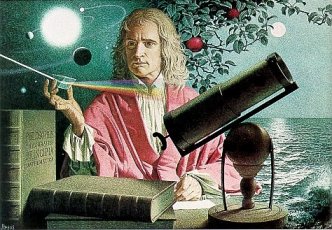
Isaac Newton

Newton spent more time studying the Bible and seeking spiritual truth than he spent on scientific research. His religious convictions and his astronomical observations supported each other, and he warned scientists not to use his discovery of the law of gravity to support any claims that the universe is merely a machine. Newton wrote:

“Gravity explains the motions of the planets, but it cannot explain who set the planets in motion. God governs all things and knows all that is or can be done.
This most beautiful system of the sun, planets, and comets, could only proceed from the counsel and dominion of an intelligent Being. [...] This Being governs all things, not as the soul of the world, but as Lord over all; and on account of his dominion he is wont to be called "Lord God" or "Universal Ruler". [...] The Supreme God is a Being eternal, infinite, [and] absolutely perfect.

Opposition to godliness is atheism in profession and idolatry in practice. Atheism is so senseless and odious to mankind that it never had many professors.”

Newton’s passion for spiritual knowledge made him especially receptive to angelic guidance, and so with the assistance of the star angels, he built the first reflecting telescope which uses a mirror rather than lenses to bend light and magnify images. Not only did this telescope assist astronomers in their cosmic searches; it helped to prove his hypothesis about the true nature of white light. 
While other people had already observed that a prism produced a rainbow of colors from a beam of white light, Newton was the first scientist to explain how and why this occurred. He theorized that when white light entered a transparent medium, such as glass or water, the different frequencies of the primary colors would move at different speeds through the medium. His experiments with prisms proved his theory, and so the mystery of the rainbow was revealed to have a natural explanation. Many Bible believers were disgruntled about the way a scientific study destroyed their concept of the miraculous rainbow, but the angels cheered this discovery. As one angel said to another: “Now people will begin to see that the miracles of Creation can be explained by natural laws. Someday they will realize that all the miracles performed by Jesus and the saints can be duplicated by people who understand their true place within the natural order of the universe – in which nothing seemingly miraculous is supernatural.”
Newton’s work also supported the heliocentric theories of Copernicus and Galileo. In 1757 Pope Benedict XIV suspended the ban on heliocentric works based on Newton's revelations. In 1822, nearly 300 years after Copernicus published his heliocentric model, Pope Pius VII finally approved a decree by the Sacred Congregation of the Inquisition to allow the printing of heliocentric books in Rome.
           This proclamation encouraged the angels who now saw glimmers of hope that humanity would awaken to the reality that there is more to the universe than the naked eye can see. Man had proved that all of the colors of the rainbow are hidden within a beam of white light. He had proved that the earth and all of the heavenly bodies of the solar system move concentrically around the sun, even though the human eye belies this fact. What other mysteries might be revealed with the assistance of Love’s divine teachers?


Chapter 18: Mohammed and the Mystic Poets

Gabriel and Mohammed


     The diversity of world religions is puzzling to many who believe there is just one God that created everything: one God whose instructions to humankind are contained in a particular set of scriptures that outline certain rules for everyone to live by. Many who follow one of these religions consider all the others to be false. They wonder why God allowed so many false religions to arise, not realizing that our true source: Love . . . does not enforce the rules and restrictions that create division and conflict between different factions of humanity.
     Each religion sheds light on just a speck of the whole story: a story that is so all-encompassing, without beginning or end, and many-faceted, that it is not possible for a human mind to wrap itself around more than a grain of it. The book you are reading now contains less than a grain of the whole cosmic story, and it’s only the bit that will make sense to a small segment of humanity.
     The diversity of the human population makes it all the more fascinating for Love to experience and observe; and all the more beautiful and loveable. Love explains to all the divine messengers of the world: “Each one of my children relates to me in a different way. Each culture and each personality type undertakes a unique journey in order to understand and connect with us. That is why I keep sending you to different parts of the world to shine your light on each individual path.  And one day, when all arrive at the intersection of these paths, they will remember their oneness with us, with each other . . . with Love!”
     A multiplicity of spiritual teachers was sent to earth throughout the millennia to create a rich and vibrant tapestry of symbols, rites and ceremonies; art forms, stories and poetry; offering endless ways to understand and experience the divine. But too often, the human ego held up the teachings that were brought to a particular region as The Only Way for everyone in the world, and for all time, to understand God. Those whose interpretation of spiritual writings or experiences differed from the accepted doctrine of the day were called heretics and frequently executed for their misbeliefs.
     Hoping to put an end to some of this religious exclusiveness, Love sent the Angel Gabriel with messages for the Prophet Mohammed to share with the people of the Arab world. Gabriel is the same angel who appeared to the Prophet Daniel, to interpret Daniel’s visions about the time when the material world of illusions and misunderstandings will pass away. Gabriel is also the angel who announced the coming birth of John the Baptist to his parents, Elizabeth and Zechariah; and the angel who announced the coming of Jesus to his mother, Mary. Gabriel has been the bearer of several significant messages to the part of the world known as the Middle East; his visits to Mohammed imply that the messages bestowed on this humble Arab were equal in importance to his previous announcements.
    Love wanted Gabriel’s messages to show the Arab world how the teachings of Moses and of Jesus could apply to them, and how they could worship the same god in their own way. Mohammed taught his followers to refer to the one god as Allah, which means “The God” in Arabic. This term was meant to clear up the misconception that all the gods of the world were totally separate beings with separate agendas. Allah’s agenda was to help people understand that they are all equal in the eyes of Love, that all of creation is One . . . and that the divine messenger Jesus does not require believers to worship him, but only to recognize the divine light shining within themselves. These messages were not any more welcome when Mohammed brought them than they had been six-hundred years earlier when Jesus taught the multitudes in Israel.
    The society that Mohammed lived in was divided by class distinctions which granted wealth and power to the upper rungs, and the people who dwelled on high were not about to give up their privileges for some silly notions about equality and oneness! Mohammed and his followers were persecuted mightily, but eventually their courage and tenacity turned the hearts of many who were thirsting for truth, and a new religion was founded. This is Islam, which means both “submission to God” and “the way to peace.” When people give up their free-will and submit to the will of God, which is the will of Love, they have found the way to peace.
    Well, as happens with all the religions of the earth, the original intent of Islam was quickly buried under misinterpretations, faulty translations, and sly twists in meaning. For instance, Mohammad had promoted human rights as an ideal to strive for, saying:
All people are equal, as equal as the teeth of a comb. There is no claim of merit of an Arab over a non-Arab, or of a white over a black person, or of a male over a female. He who honors women is honorable, he who insults them is lowly and mean. He who has a female child and does not insult her and does not prefer his sons over her, will be ushered by God into paradise. (One River, Many Wells, by Matthew Fox, pp. 151-152)
     Like Jesus, Mohammed did his best to overturn the oppression of women in the patriarchal society he lived in. His life and words planted the seeds of a new paradigm for women, but after his death these seeds were quickly buried beneath the cultural mindset that had oppressed women for hundreds of years and wasn’t about to quit.
    Another twist of meaning in the Koran, Islam’s holy book, regards the Arabic word, “jihad” which means “striving for God,” but has been misinterpreted to mean “holy war” or “fighting for God.” One of the passages that refers to jihad is interpreted this way by peace-loving Muslims: “O Prophet! Strive hard against the unbelievers and the hypocrites, and be firm against them. Their abode is Hell, - an evil refuge indeed.” (9:73, 66:9)
    When the Archangel Gabriel gave Mohammed these words, he was referring to the unbelievers as those who don’t want anything to do with divine love. Gabriel explained: “When an unbeliever chooses to live on a mountain island; separate and above the rest of creation, it doesn’t matter if it’s an island of Christians, Muslims, or members of some other exclusive sect. These people will dwell in a lonely Hell until they are ready to dive off the island and swim across the ocean to join the rest of the world.”
    The climate on these exclusive islands is particularly hellish when their occupants demean and kill those who refuse to climb ashore. But the believers in Love and the oneness of All-That-Is can’t conceive of killing another person since every single being is a brother or sister. Thankfully, some human hearts have always been open to the messages of Love, whether from angels, nature, music, or another medium, and these people have been the bearers of truth throughout time and space. These are the mystics: people who experience the divine first-hand, and so have no need of doctrines, laws, or specific disciplines to remind them to stay on a particular path.

Rumi by Hossein Behzad

    Among the mystics are the artists, musicians, and saints we have already met, and also the poets. One of the best-known of the mystic poets is Jalalud'din Rumi, who lived in Persia from 1207 to 1273. Rumi was a Sufi. The Islam faith gave rise to Sufism, a mystical teaching and way of life that embraces the experience of the divine while circumventing the restrictive requirements of a particular faith: a pilgrimage to a holy city, the proper method of baptism, a meditation mantra, spoken confessions, or counted prayer beads. Each religious faith requires certain actions of its followers, but how often are these actions accompanied by a deep knowing of divine love and oneness? Rumi advised that words could not adequately describe the experience of mystical union, and yet he turned to poetry to express the ecstasy of knowing divine love. As inadequate as they may be, his words still bring tears to the eyes of men and angels, who feel their power.
      Rumi’s poem, “Buoyancy,” describes how a faith born of personal experience differs from one imposed by creeds and commandments.

Love had taken away my practices

and filled me with poetry.


I tried to keep quietly repeating,

No strength but yours,

but I couldn't.


I had to clap and sing.

I used to be respectable and chaste and stable,

but who can stand in this strong wind

and remember those things?


A mountain keeps an echo deep inside itself.

That's how I hold your voice.


I am scrap wood thrown in your fire,

and quickly reduced to smoke.


I saw you and became empty.

This emptiness, more beautiful than existence,

it obliterates existence, and yet when it comes,

existence thrives and creates more existence!


The sky is blue. The world is a blind man

squatting on the road.

 
But whomever sees your emptiness

sees beyond blue and beyond the blind man.


A great soul hides, like Muhammad, or Jesus,

moving through a crowd in a city

where no one knows him.


To praise is to praise

how one surrenders

to the emptiness.


To praise the sun is to praise your own eyes.

Praise, the ocean. What we say, a little ship.


So the sea-journey goes on, and who knows where?

Just to be held by the ocean is the best luck

we could have. It's a total waking up!


Why should we grieve that we've been sleeping?

It doesn't matter how long we've been unconscious.


We're groggy, but let the guilt go.

Feel the motions of tenderness

around you, the buoyancy.


    When angels cradle a human soul, one that’s yearning to break free from the isolation of the island where it dwells, the soul feels the tender administrations of these divine ones, and the buoyancy of floating in the ocean of divine Love that connects us all.

Utopia

     Idries Shah, a Sufi author who lived in the 20th century, tells a fable about a utopian civilization that is forced to immigrate to an island when their leader tells them that their homeland will be uninhabitable for about 20,000 years. What is going to happen to this homeland is left to our imagination. Perhaps there was going to be a cataclysmic change in the environment that would make this land too hot or too cold for survival. Or perhaps the leader of the people known as “El Ar” decided that life in paradise was getting too easy and it was time to stir up some excitement by sending the contented chicks off to a new nest. Whatever the reason, the entire population had to pack up and move to an island where life would be hard compared to what they were used to. The pain of losing their past life was softened by a procedure that helped the El Ar to forget their paradise home.  Only a vague sense of longing remained; a lasting reminder that the island was not their true home.
     The fable goes on to describe existence on the island, and how certain members of this society protected the secret instructions for shipbuilding and swimming, necessary skills for people to escape the island to another island that would serve as a stepping-stone back to the El Ar’s country of origin. The secret-keepers made it known that an individual must attain certain attributes before qualifying for swimming or shipbuilding lessons. One man who wished to learn how to escape the island, but lacked the right qualifications, decided to sabotage the whole operation by creating a new philosophy of life that would do away with the need for swimmers or shipbuilders. The new philosophy reassured people that they were already complete human beings with nothing more to learn; that the story of life beyond the island was a myth, and that  there was no reason to build ships or learn to swim, because there was nowhere else to go.  This philosophy caught on like wildfire, and before long, the secret-keepers were being hanged for heresy because they could not produce visible proof of their claims.
     The Sufi’s angels nudge them to use a clever code to disguise the true meaning of their tales. For instance, the name of the original community in this fable, El Ar, can be rearranged to spell “Real.” The island’s new philosophy, which was based on science, was known as “Please,” a word that rearranges to form the word “Asleep.”
     In our world, the mystics and poets are the swimmers and shipbuilders. Many of the mystics keep their experiences to themselves; and nobody can accuse them of heresy because their oneness with Love and All-That-Is remains a private affair. But Love’s muses delight in their ability to draw forth fiery words of divine passion from mystics such as Rumi, whose poetry invites spiritual pilgrims to venture off the island where they’re marooned, without offering the kind of “proof” that religious institutions demand.

Hafiz

     In 1341 the Archangel Gabriel again visited a Muslim poet, this time a young man who wrote under the name of Hafiz, a title given to one who has memorized the Koran by heart. Gabriel bestowed the gift of poetry on Hafiz, and he who was already a poet spent the rest of his life writing exquisite poetry, that was loved by the people of Persia and hated by the orthodox clergy of Islam.

The Stairway of Existence

We

Are not

In pursuit of formalities

Or fake religious

Laws,


For through the stairway of existence

We have come to God's

Door.


We are

People who need to love, because

Love is the soul's life,


Love is simply creation's greatest joy.


Through

The stairway of existence,

O, through the stairway of existence, Hafiz


Have

You now come,

Have we all now come to

The Beloved's

Door.

    Mohammed rejoices when he hears this poem. He calls out from his celestial abode: “Oh Islam, listen to these inspired words! Come to the Beloved’s Door, and join me in Love: creation’s greatest joy.”
    Those who have ears to hear, do. Those who don’t . . . do not.


Friday, February 8, 2013

Chapter 17: Team Love

Ceres by Masaki Hikari
                                                       

When Love’s children decided to focus on their differences, instead of the connections that make us One, Love said to all of the divine messengers: “If we can just get people to live together in communities, they will support each other, and working together they will create a peaceful world.  Now they wander around, hunting and gathering their food wherever they can find it. If some of you teach them how to plant crops and domesticate animals, they can stay in one place. Their tribes will grow in numbers, and they will have more opportunities to learn about loving other people!”
So Love appointed gods and goddesses to teach the art of sowing and plowing in different parts of the world.  Isis was the one who went to Northern Africa.  Demeter-Ceres worked with the people who would build the Greek and Roman Empires.  There was Uga-no-Mitama, who taught agriculture to the Japanese; Ardwinna, who went to the British Isles; Lakshmi who helped the people of India; Hou-chi, who went to China;  Itzpzpalotl, who taught the Aztecs of Mexico; and quite a few others whose names didn’t made it into the mythology books. 


         As tribe members learned the art of agriculture and gave up their nomadic lifestyle; settlements cropped up near rivers and seas. Inhabitants of the various settlements stressed the differences between themselves, and easily came up with excuses to raid each other to obtain goods, people to enslave, or more land to occupy.
         "At least the members of each settlement are learning to love each other,” one of the angels said to another.
“Usually,” responded a sympathetic goddess.
“I’d say sometimes,” another angel commented.
“Right,” the first angel sighed.
“Camaraderie among people on the same side of a conflict is a good first step toward the achievement of Oneness,” Love proclaimed. “Let’s not feel discouraged just because our children are slow in remembering their true nature. We will persevere, and all will be One again.”
“Since people want to engage in conflict, and they’re always trying to best the enemy, let’s teach them how to compete peacefully. If they engage in competitive games, they will experience solidarity with their comrades, without having to kill their foes,” Love said, with an extra shimmer of Light. “And they may find out that it’s even more fun!”


A flurry of gods, goddesses, and angels went out to all parts of the world, to teach humanity the art of team sports. The first ball game was introduced in Mesoamerica, where the people were in great need of an outlet for their violent tendencies. Love’s messengers taught the Mayans how to make balls by extracting latex from rubber trees and mixing it with the juice from Morning Glory vines, which grew abundantly throughout Mesoamerica, which is now known as Central America. The gods had as much fun as the Mayans did, as they invented and taught different ball games in each settlement or city.  One of these games required team members to pass the ball through a ring by using their hips. In Teotihuacan, players hit the ball with a wooden stick. In Mexico, the Aztecs learned a game in which points were gained when the ball hit the wall behind the opposite team.  The team that managed to hit the ball through a ring was the victor.
It was Love’s intention that these games be played purely for enjoyment, but human beings find it difficult to focus on fun when they are continually haunted by fear: the fear that someone else will get more than their fair share of the earth’s abundance, the fear of the unknown, or the fear that they may accidentally commit a sin that will anger the gods and cause disease, famine, earthquakes, or drought.
The Mesoamericans thought they had to make sacrifices to their gods in order to maintain the balance and cycle of life.  Just as they killed animals for food, and used their rotting entrails to fertilize the ground so that it could bring forth new life, the Mayans and Aztecs believed their gods needed sacrifices of animals for food and fertilizer, to keep them fat and happy. So some of their ball games became religious events which ended in the ritual sacrifice of the losing team, or at least certain of its members; for instance, the captain! 
“So much for that plan, Love,” said Xochipilli, the Aztec god of games. “I taught them how to play a peaceful game and look what they’re doing!”
“I agree, it’s a shame,” Love commiserated. “But this is no reason to despair. I never said the road to enlightenment would be easy or short. There is still less bloodshed in the game than there is in a battle. In battle, the warriors’ hearts are filled with hatred. In games, most of the players are striving for excellence, knowing that their best efforts will support their teammates and please the gods they believe in. This is one little step toward our goal of a united people. And we have all the time we need to guide them the rest of the way!”
Xochipilli laughed at Love’s joke about time. And in that existence outside of time and space, Love’s messengers have continued to invent all sorts of games and athletic events to share with humankind.  The team sports have taught people about camaraderie, and how to cooperate with other people to achieve a goal. And every athlete, whether a member of a team, or a participant in an individual sport, has learned how to strive for excellence: an ability that has served humanity well in every aspect of their evolution.
In ancient times, Love’s messengers  inspired the Greeks to hold a contest for athletes at Olympia. The first Olympic sporting events included discus and javelin throwing, equestrian events, jumping, running, and wrestling.  The Olympic Games encouraged people to admire the diversity of excellence among athletes.


“Eventually people will come to admire the diversity of the human race in every aspect.” The angels and gods agreed, congratulating each other on the farsightedness of their scheme. And because the Olympic Games were inspired by divine beings and considered to be a religious event, it was sacrilegious for anyone to commit a crime or to launch an invasion during the games. A respite of peace for a few days, once every four years!
 But once the Olympics were initiated, men stopped listening to divine wisdom and employed some of their own ideas. They decided to dedicate the event to Zeus, honored by the ancient Greeks as the king of the gods: god of peace and justice. The great sculptor, Pheidias, carved a 42-foot high gold and ivory statue of Zeus for the temple at Olympia. This marvel did not upset the gods very much, especially not Zeus; even though it stole some of the glory from the athletes who were supposed to be the main honorees of the games. What really upset Love’s messengers was the introduction of boxing and pankration to the list of Olympic events.
“Pankration!” Zeus rumbled when he heard about it. “What will those humans think of next!”
The Greek term, pankration, means “all powers.”  The sport allows all powers of strength, including those used in boxing and wrestling, as well as chokeholds and kicking an opponent in the belly.  The poet, Xenophanes, labeled pankration “that new and terrible contest.”  As if that wasn’t terrible enough, the male athletes decided to limit the games to men and they forbid married women to attend. They required the priestess who represented Demeter to grace the games with her presence, and they enjoyed showing off for the unmarried maids. But a matron who dared to enter the stadium during the games risked losing her life. Oh well . . . so the Olympics were a mix of good and not-so-good elements, as were all things once they were touched by human hands and human minds.

Love continued to dispatch athletic coaches to earth to teach the rules of the sports that would appeal to different groups of people in various times and places. When the Persian Empire’s cavalry developed the game of polo to train for battle, some of Love’s emissaries showed the horsemen how to divert their skills into a sport that would become a national pastime, although the sport was enjoyed mainly by the nobility. Other ball games, such as baseball, football, soccer, and cricket, were not introduced until the 1800’s when advancements in industry brought more leisure time to the middle classes.  

Love’s angels had been deeply involved in the industrial revolution because the wisdom of All-That-Is called for a shift from humanity’s survival-oriented existence to a lifestyle that allowed time for the pursuit of passionate interests. When team sports were added to the array of solitary activities that people chose to devote themselves to, players learned the importance of helping others to succeed in order to win a game. And realizing that two opposing teams have to agree to follow the same rules was a major step toward learning the advantages of cooperation.
Over the centuries, as athletes were learning how to cooperate as sports team members, societal structures were also growing and changing with the guidance of divine mentors. Settlements and tribes melded to form city-states; empires grew and crumbled, and nations emerged from the rubble. Countries were ruled by kings who amassed power and wealth by crushing the populace with heavy taxes and stringent laws. Despite their oppressive governments, the people of each nationality developed love of country because of their shared history, culture, traditions, arts, and religious beliefs. The angels were rarely able to find a crack in the well-armored ego of each country’s aristocracy through which they might whisper messages of love; but they found many ways to encourage the peasantry who were always looking for distractions from the grinding poverty they lived in.
The establishment of national governments planted the seeds of patriotism in the hearts of citizens everywhere. A deep love of country served the goals of both worldly and heavenly rulers. Kings and queens, and later presidents and prime ministers, used the patriotism of their people as motivation for war. How easy it was to send young men into battle to defend their homeland when the real purpose of the war was to acquire power and wealth for the beneficiaries of dualism. But patriotism has also served the goals of Love, fostering feelings of oneness among millions of individuals who share a similar ethnicity.
“Oh, Love, the number of countries in the world keeps growing!” Mother Earth exclaims with astonishment. “How will we ever bring them together into one harmonious creation when there is so much diversity?  And nearly everyone thinks their country is the greatest!”
“True. True.” Chuckles Love. “But the greater the diversity, the greater will be the Love when all realize they are equally great, wonderful, and divine.”


Chapter 16: Mary, Mother of Love


Mary of Nazareth delivered Jesus into a world where women were looked upon as property to be traded or sold. Women were considered to be inferior to men: they had no voice in the Temple, or anywhere in public. Men were not allowed to speak to a woman outside of his family, and yet Jesus spoke to many women, including gentiles and foreigners. Jesus loved men and women equally, and he did all that he could to restore women to a position of respect. While women and girls were not allowed to study the Torah, Jesus taught as many women as would listen to him. And though Jesus chose twelve men to be his disciples in keeping with the requirements of society, there were many women in his inner circle of followers. It was these women who accompanied him to the cross, who stayed with him throughout his trial; and it was two of these women to whom he first appeared after his resurrection.
Jesus did everything he could to remind men that women were equally loved by their creator. While he did not succeed in raising women to the position of equality he wanted them to have, his respectful attitude toward the female gender did open the way for women to hold positions of importance in the Way Followers’ religion. There was Priscilla of Rome, who, along with her husband, Aquila, risked her life by spreading the teachings of Jesus. There was Lydia of Macedonia, who became a leader of the first church to be founded on the European continent. There was Phoebe of Corinth, highly respected by the Apostle Paul as a deacon and patron in the church at Cenchrea.
Saint Paul also revered his cousin, Junia, who he wrote was “prominent among the apostles” (Romans 16:7). Later Bible translators changed her name to Junias, which could have been a man’s name – except that such a name was not used in ancient Rome!  Even John Chrysostom, a theologian who lived in the fourth century, who did not usually speak highly of women, wrote of Romans 16:7, "O how great is the devotion of this woman that she should be counted worthy of the appellation of apostle!"2
In spite of the efforts of Jesus and Paul to elevate the status of women, most men continued to enjoy the power that a patriarchal society gave them. When the first church Fathers gathered to make the decisions that would bar women from the priesthood forever, one of them said slyly: “If we point out that Jesus and his apostles were all men, and they chose only men to be priests, that will settle the point for all time.”


“But what about Junia?” another replied. “Saint Paul regarded her highly among the apostles.”
“Oh, you mean Junias?” the first Father said. “Junias lived 300 years ago. Who can prove there was a woman named Junia if we write the name Junias in our scriptures?”
“Hah! You are so clever, wise one.”
How easily civilization slipped back into the old patriarchal ways, before women even had the chance to emerge fully from the murky corners of society where their men had been keeping them for hundreds of years. Little did the church Fathers know that the time spent in voicelessness; nurturing their families, sacrificing their own needs, quietly working in the background of life, was strengthening the connection between the feminine spirit and Divine Love. 
In countries where belief in a male God was required, and women’s voices were not heard in temples, churches, or governing bodies, the divine feminine maintained a place in human consciousness through the personality of Mary, mother of Jesus; through the female saints; and through courageous women of the Bible such as Sarah, Rachel, and Esther.  Mary was raised to the position of Queen of Heaven by the very patriarchs who insisted that the kingdom of heaven belonged to a male godhead, and that the power of the church should remain in their masculine hands.  But the most machismo of these men recognized their need for a gentle, motherly goddess who would soften the edges of the harsh decrees made in the name of the judgmental Father God they themselves had placed on heaven’s throne. And while they have never referred to Mary as a goddess, her titles: Queen of Heaven and Mother of God, have allowed devotees to adore her with as much love and devotion as the Egyptians had bestowed on Isis, if not more.
Jesus had taught his followers to pray to their heavenly father – radical enough for the Jews who were not accustomed to thinking of their god, Yahweh, as their parent.  Jesus realized that these patriarchal folks would never accept the idea of God as mother, so he did not even suggest it. And yet, the church founders encouraged their members to pray to Mary and think of her as their heavenly mother! These men came from cultures that had worshiped goddesses before the advent of Christianity. They were Greeks, Romans, and Egyptians, who had worshiped Demeter, Athena, Isis, and many other goddesses. And then there were the founders of the Celtic church: men who had worshiped Aine, the Irish goddess of love, growth, cattle and light; Branwen, Welch goddess of love and beauty; Habondia, British goddess of the harvest, abundance and prosperity, and many others. They knew that people must connect with the feminine qualities of divinity if they are to experience sincere devotion to a religion.
For a thousand years, millions of people have shown devotion to Mary, reciting over and over the beloved words:

Hail Mary, full of grace, the Lord is with thee; blessed art thou amongst women, and blessed is the fruit of thy womb, Jesus. Holy Mary, Mother of God, pray for us sinners, now and at the hour of our death.

Because so many people believe that Mary listens and cares for them, Mary, unlike her divine but forgotten sisters, can manifest and speak to people all over the world. Some of her apparitions have been approved by the Roman Catholic Church; some have not. Mary does not seek approval for her appearances – she simply goes where she pleases to bestow her mother-love and healing gifts on the world’s children. She reminds us that we are loved, and that we should love others just as she loves us. Mary has appeared to devotees in England, France, and Ireland; Spain, Portugal, Egypt; Vietnam, Venezuela, Mexico, and Bosnia. Any spot where Mary has appeared is considered sacred and becomes a destination for pilgrims who may travel great distances to visit, to pray, and ask for healing. Miracles often occur during these pilgrimages.
When Mary makes a request for constant prayer; the building of a shrine; the unearthing of an underground spring from which healing water flows . . . the visionaries feel compelled to publicize their experience in order to make Mary’s wishes known. But Mary and her sister goddesses also make quiet visits to lonely, sick, or sad people who just need the touch of a mother’s hand or the sight of loving eyes gazing into their own.


by Tim Ashkar

During the era of slavery in the United States, when children were sold away from their parents, Mary would appear as the Black Madonna to motherless children, like Laura. When she was eight years old, Laura was taken from her mother and her twin sister to be a wedding gift for Benjamin and Elizabeth Jones. When she cried at night, muffling her sobs in the crook of her arm, so as not to awaken her mistress, Mother Mary would come to Laura, lift her up, and cradle her wordlessly in her arms. No words were needed; no message given – just the soft warmth of mother-love, to remind the little girl that she was not forgotten; that she was an important part of the great Divine Love that had given her life. 


Chapter 15: The Goddesses of Love


In our forgotten life, beyond time and space, all opposites dwell in harmony. Love embraces the masculine and the feminine, hard and soft, hot and cold, yin and yang. In the material world, where separation creates competitiveness, the balance of opposites has always been precarious. When humanity first ventured out in physical bodies, women were held in higher esteem than men because the miracle of birth amazed everyone. After a few million babies had been born, the process of childbirth lost some of its fascination, and some societies became more egalitarian with men and women appreciating the contributions of the opposite sex.
As humanity’s memory of oneness grew fainter, the separation between men and women became more distinct. Man envied woman’s ability to create new life, and woman envied the freedom of man unhampered by the needs of their children. The human desire for power was out of control, and while every man could not hold a lofty position in society, every man could have power over his wife, daughters, and maid-servants. Men discovered how easy it was to use their physical strength to enforce laws that gave them power over women, and so they did.  
Love has always been unhappy to see one part of creation being oppressed by another; so the divine feminine spirit has been manifesting in various forms throughout time, to remind us that women and men are equally important where Love is concerned. There is a myriad of goddesses watching over humanity, making sure that our neglected feminine traits are not forgotten altogether.  To each part of the world, Love has assigned goddesses that suit the culture and temperament of the people who live there.

The Goddess Isis

The goddess Isis first entered the world in ancient Egypt, where she taught mothers how to care for their children with loving firmness, how to domesticate men so they would make good husbands; and how to grind corn, make bread, spin flax and weave cloth. Isis also appeared in ancient Greece and Rome, and she was deeply loved by the people of all three areas.
Isis was a good friend to Demeter, Greek goddess of the bountiful harvest, who was known to the Romans as Ceres.  Isis and Demeter shared an interest in nurturing Love’s children. Together and separately, they appeared in homes and fields to show people how to grow different varieties of grain, how to preserve it; how to bake it in nutritious breads, and cook it in cereal.
Isis and Demeter share tips and recipes with Annapurna, Hindu goddess and symbol of the nourishment and care that mothers provide for their children. Annapurna has the ability to supply food to the hungry in unlimited quantities; just as Jesus fed the five thousand with five loaves of bread and three fish; just as a human mother feeds her own child an endless supply of milk and love.  Isis, Demeter, and Annapurna promise that we humans will one day learn that the secret to a boundless supply of nourishment lies in our ability to give from the heart, without reservation.
Isis and Demeter have been largely forgotten, along with most of the other ancient gods and goddesses who were replaced by the Judeo-Christian image of one Father-God. But Annapurna and her sisters are still revered in India. Followers of the Hindu religion recognize that the Supreme Being envelopes both masculine and feminine traits and Hindus know that one has to understand the feminine aspect of the divine, in order to know the ultimate truth.  Love has rewarded this faith by providing the Hindus with many goddesses, each one portraying a unique characteristic of the divine mother, Shakti. 

The Goddess Saraswati

Saraswati, another favorite Hindu goddess, is a patron of the arts, music, knowledge, and wisdom. Saraswati, divine consort of Lord Brahma, creator of the universe; grants the powers of speech, wisdom and learning to the devotees who call on her. She chooses to fly on the back of a swan rather than the peacock that preens for her attention, because the white bird symbolizes spiritual purity, while the peacock reminds us of those self-focused humans to whom material things are all-important.
Saraswati shares much in common with Athena, Greek goddess, who was called Minerva by the Romans. Athena was known for her wisdom, and she imparted to humans her knowledge and skill in weaving, pottery, music, and horsemanship. Like her divine sisters, Athena was relegated to the pages of mythology books when the Christian Church Fathers decreed that the godhead must be confined to Father, Son, and Holy Spirit. However, Athena’s anonymity does not prevent her from participating in the affairs of humans who continue to need more divine assistance than they realize. And Athena maintains a close friendship with Saraswati, meeting with her frequently to discuss the needs of their charges.
When Saraswati and Athena need advice about helping people to discover the feminine wisdom within themselves, they consult with Tara, Mother of all the Buddhas. Unlike other goddesses, Tara was once a human: a princess whose name was Moon of Wisdom-knowledge. She was a deeply devoted disciple of Buddha, and longed to attain enlightenment herself so that she could relieve the suffering of all living beings. When she achieved this goal through meditation and pure desire, the monks who knew her suggested that she might be more effective if she was reborn as a male. The princess responded to their suggestion with these words: “There are many who desire enlightenment in a man's body, but none who work for the benefit of sentient beings in the body of a woman. Therefore, until the Wheel of Suffering is empty, I shall work for the benefit of sentient beings in a woman's body."
Like Saraswati, Athena, and the other goddesses, Tara understands that much of the world’s suffering is caused by an imbalance between masculine and feminine, and the strict division that separates the two. Love’s representatives: angels and archangels, goddesses and gods, divine lords and ladies -- all weep when they see men pushing women to the back of their places of worship; husbands beating wives; fathers raping daughters. Whenever one faction of humanity oppresses another, the result is more suffering for the whole. The oppressor prolongs the brokenness of the world with his inability to love and honor all of creation, and he, too, lives among the fragments of the life he has shattered.


Tuesday, February 5, 2013

Chapter 14: Seeing through the Eyes of Love


       The ability to create must be the most enjoyed of all the gifts Love has bestowed on us. To be creative is to be partners with Love for whom creativity is what life is all about. The angels exercise their artistic flair when they swoop and tumble across the sky, making swirls and billows with cloud fluff as their medium. Their divine creativity strikes us with awe whenever we pause to gaze at the sun rising or sinking in a blaze of colors; the graceful design of a single iris petal; or the lacy pattern of autumn leaves glistening yellow against a topaz sky. The angels of beauty delighted in demonstrating their art to primeval people, and showing them how to use available materials to create their own art.
       One of the earliest art forms was engraving, with the artist using flakes of sharp flint or stone picks to etch designs on rock formations and cave walls.  Just as a modern art student masters the fundamentals of art by learning to draw before moving on to the colors and texture of paint, primitive artists had to learn to draw before they were taught how to mix and use paint.
The first paint colors were red, iron oxide, and black, which were created by mixing mineral fragments with cave water and vegetable and animal oils in barnacle shells. Different methods were used to apply the paint, including hollow bird bones that served as tubes from which artists could blow the desired colors. 
       The angels encouraged the people of ancient times to paint on cave walls where their art would not be destroyed by the elements. These etchings and paintings were humankind’s first creations that were not necessary for daily life. They did not aid them in the attainment or preparation of food; and they did not keep them warm or safe. Many of their family members thought the artists were wasting their time! But some experienced awe and joy when they beheld the handiwork of their comrades who could actually duplicate the image of an animal with their own hands. 


       The act of producing these paintings gave their makers a taste of the joy that Love experiences when creating something unique or beautiful in nature. Other cave-dwellers saw the light in the faces of these artists as they worked, and realized they were experiencing a kind of bliss that transcends the everyday pleasures of life. Although they could not explain their feelings to anyone, these cave artists were lifted from the material life into the spiritual realms as they worked, where they experienced oneness with the divine, with the animals they painted, and with other artists they would never meet in the physical world.
       The act of creating a piece of art can be so transformative that some artists are willing to sacrifice their place in society or the security of a regular income in exchange for a life co-creating with Love.  Although other people admire the artists’ work, some look down on them for “wasting their time” on impracticalities. In ancient Greece, where intellectual pursuits were valued above other types of work, those who practiced the visual arts were looked down on as manual laborers.  Plutarch, a Greek historian and essayist wrote candidly in Life of Pericles, II:  "we admire the work of art but despise the maker of it.” 
       The artists of ancient Greece produced some of the finest sculpture and architecture the world has ever seen. Some of their masterpieces were inspired by the gods and goddesses that they worshiped; and while the intellectuals of the day relied on reason as their source of knowledge, the artists exercised their imaginations along with the required technical skill to create the beautiful statues they were known for. Those who scoff at the imagination as the source of pure fantasy do not recognize what artists know, that the imagination and the creative arts flow from a sacred unseen place, through the human mind, and into the material world where they can be shared and enjoyed. The Greek artists were able to ignore the derision of the upper class because they treasured the meaningfulness of a life spent so close to divinity. The statesmen who hired them to sculpt statues for public monuments and temples would walk past the artisans with their noses in the air, not realizing that the sculptors were engrossed in a godlike experience as a chunk of marble turned into a magnificent form beneath their hands.
       Their gods and goddesses encouraged the artists throughout the Greek mainland and colonies to compete with each other, to see who could produce the best and most novel creations. Love knew that competition among artists would be a healthy substitute for violent conflict, and also prod each individual to strive for excellenceThe gods and goddesses, and the angels, knew that a desire for excellence in a person’s work will stimulate a need to excel in all facets of existence, and sometimes that quest for excellence will spill over into the spiritual life. In their spiritual lives the ancient Greeks worshiped a pantheon of gods and goddesses to whom they attributed numerous human frailties, thus bringing the divine down to their own level instead of raising themselves to a higher one. But in the process of chiseling and smoothing the marble features of a divine or human being, the artist, so deeply focused in the present moment, would find himself in a lighter, more peaceful place, where thoughts of greed and violence could not enter. 

Venus de Milo

       Love delights in the companionship of artists immersed in their creative work. However, in ancient Greece, Egypt, and Babylonia, the images made by painters and sculptors evoked so much awe and reverence in the beholder that many people worshiped the statues and painted images as if they were gods. The worship of stone and metal idols increased the separation of humanity from Love because it emphasized the concept that gods have physical bodies that set them apart from us. And because these gods were endowed with human traits such as greed, envy, and revenge, they were blamed for any disease, drought, or storm that threatened the lives of their worshipers. Blood sacrifices were made to appease the idols, but the fear and horror that accompanied these rituals just amplified the negative energy that was already swirling around those people who had lost their inner connection with Love.
       When Moses wrote down the ten commandments of Love for his people to follow, the first commandment was: “You shall have no other gods before me,” and the second one was: 
“You shall not make for yourself any carved image, or any likeness of anything that is in heaven above, or that is in the earth beneath, or that is in the water under the earth; you shall not bow down to them nor serve them. “(Exodus 20: 3-5) Moses assumed that Love made this law due to a jealous streak. But the real reason was simply that Love wanted people to seek within for their own divine light, the same way that Moses had, and to realize that the true nature of all creation is spiritual. Worshiping images made of gold or bronze solidified their dependence on the material world to take care of their needs.
       The Egyptians went a step further than the ancients of other cultures in over-emphasizing the importance of the material world, believing as they did that the dead had to be protected and provided for by the living. If a soul was to enjoy the afterlife, its body had to be preserved; food, clothing, and tools were to be placed in the tomb with the body; and artists had to be hired to decorate the tomb with wall paintings and models of the deceased engaged in those earthly activities that he or she would not want to give up.  Survivors were comforted when they stood before the scenes of their loved ones hunting, fishing, or sitting at a banquet table.  
       The Egyptian deities and angels sighed over the vast amount of resources and effort spent on the souls of the royal and noble dead, while their living slaves had to make do without any of the same luxuries.  In the earliest days of Egyptian civilization, live slaves were even buried with their masters so they could continue to do their dirty work in the next world. But the servants of Love laughed among themselves when an upper class Egyptian passed over and discovered that their slaves were working alongside the angels to teach other souls how to be more loving and compassionate toward each other, no matter what their station in life. One of the first lessons that Love was able to impart to the Egyptians was that small figurines could serve as substitutes for live slaves in the tombs of the dead. And so the art of sculpture actually saved human lives, and the spirits of Love rejoiced throughout Creation.

 (http://www.artchive.com/artchive/C/cave.html)